
ABA therapy for bilingual children can account for the languages they hear and use each day. A child who hears Spanish at home and English at school may need help communicating in both settings. Receiving therapy in English does not automatically mean a family needs to stop speaking Spanish.
Caregivers need support, too. A parent may prefer English for everyday conversations but Spanish when discussing treatment decisions. Those preferences belong in conversations about therapy from the beginning.
Key Points:
- ABA therapy for bilingual children should address communication with the people involved in their daily care.
- A bilingual clinician, trained interpreter, and translated documents provide different kinds of support.
- Speech-language assessments should consider every language the child uses, including language needs on communication devices.
Does Bilingualism Cause More Language Delays in Children with Autism?
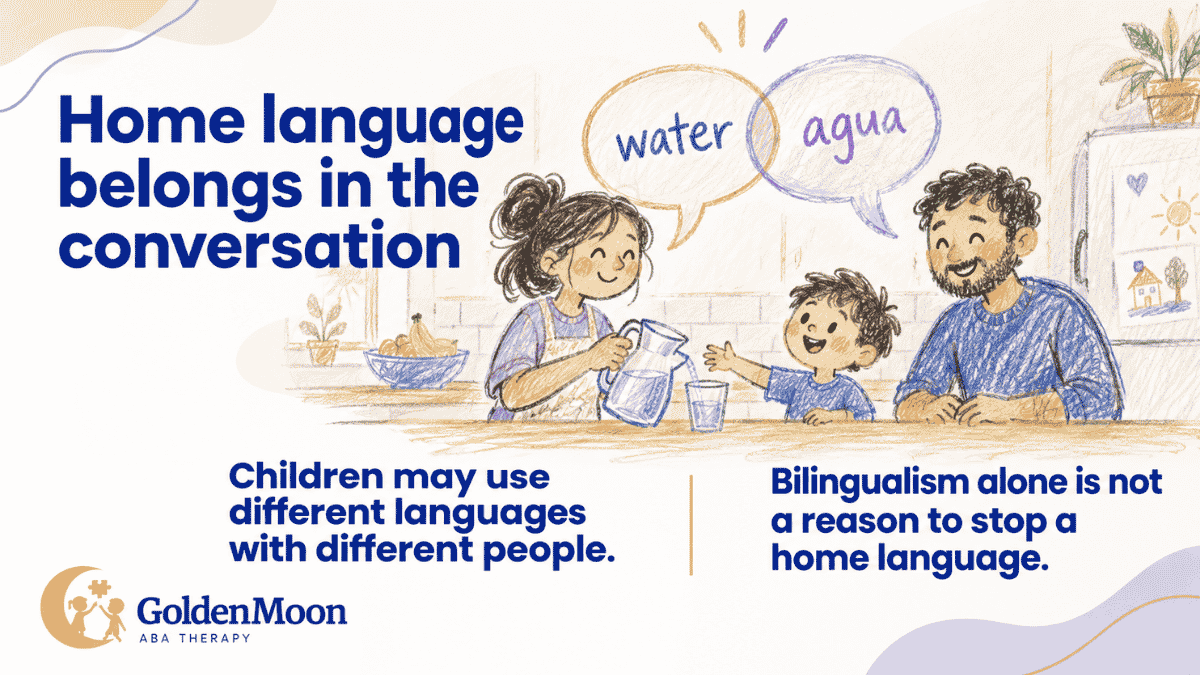
Research summarized by the American Speech-Language-Hearing Association (ASHA) indicates that children with autism raised in bilingual environments are not more likely to have language delays than autistic children raised with one language. Bilingualism alone is not a reason to remove the home language.
A child may understand one language more than they speak it or prefer different languages with different people. The care team needs to understand those differences before drawing conclusions about communication skills.
What Should Families Tell the ABA Team?
The ABA team should know which languages your child hears, understands, and uses. Everyday observations can help explain your child’s communication without turning family time into a test.
A short list can cover:
- People: Languages used by parents, grandparents, siblings, and other caregivers.
- Settings: Languages used at home, school, and daycare.
- Understanding: Familiar words or requests your child responds to.
- Expression: Words, gestures, pictures, or devices your child uses.
- Caregiver preferences: Languages adults prefer for meetings and written information.
For example, a parent might ask, “¿Quieres agua?” meaning “Do you want water?” The child might say “water,” point to a cup, or select a picture. Each response gives the team information about what the child understands and how they express a need.
ASHA includes these kinds of details in a child’s language history, which helps professionals understand communication across languages and settings.
How Home Languages Connect to ABA Goals
ABA, or Applied Behavior Analysis, teaches skills that support daily life. A Board Certified Behavior Analyst (BCBA) assesses a child’s needs and develops treatment goals with the family.
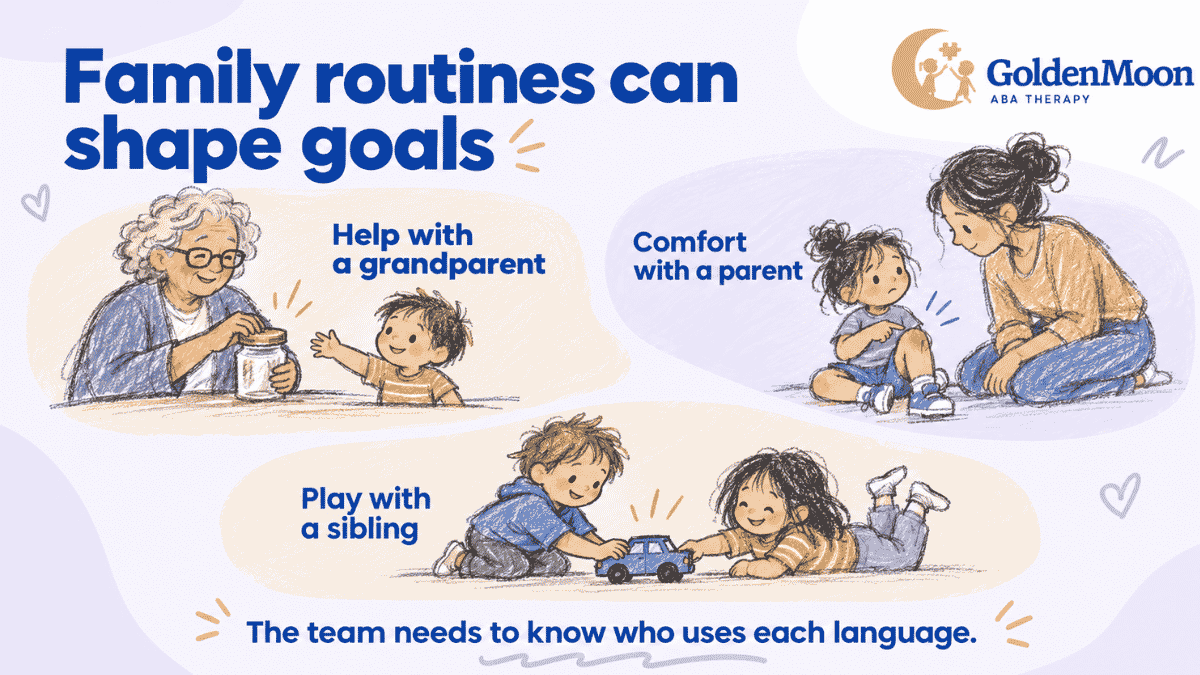
For bilingual households, those discussions should include the people a child needs to communicate with. Possible priorities include asking a Spanish-speaking grandparent for help, telling a parent something hurts, or asking a sibling to play.
At Golden Moon ABA, our home-based ABA sessions take place in familiar surroundings. Registered Behavior Technicians (RBTs) carry out BCBA-designed plans during activities such as meals and play. Families can bring examples from those same routines into goal discussions.
A family might explain that their child requests help in English during therapy but has difficulty asking a Spanish-speaking relative. That gives the BCBA a specific situation to discuss when planning support.
How Caregiver Training Supports Family Routines
Caregiver training helps adults learn how to support their child’s treatment goals between sessions. A BCBA may demonstrate a strategy, help a caregiver practice, and discuss what happens at home.
For example, a caregiver learning to support requests for help needs to understand when to offer assistance and how to respond. Language access affects whether that teaching makes sense to the adult using it.
Through our parent training services, BCBAs teach strategies tied to each child’s plan. We encourage primary caregivers to participate whenever possible and offer training at home or through virtual sessions. Families can ask about including a grandparent or another regular caregiver and discuss any language assistance needed.
What Language Support Can Families Ask About?
Families can ask about bilingual clinicians, trained interpreters, and translated documents. These options serve different purposes.
| Type of Support | What It Provides | Question to Ask |
|---|---|---|
| Bilingual clinician | Clinical services in another language, within the professional’s training and skills | “Who can work with our child in our family’s language?” |
| Trained interpreter | Help communicating during spoken or signed conversations | “Can an interpreter join meetings about our child’s care?” |
| Written translation | Documents in another language | “Can we receive forms and instructions in our preferred language?” |
ASHA distinguishes interpreting from written translation and explains why language assistance requires appropriate skills. Speaking another language does not automatically qualify someone to interpret clinical discussions.
Translated forms also do not establish which languages a provider can use during therapy or caregiver training.
Questions to Ask Before Therapy Starts
An early conversation can help families understand how communication will work throughout care:
- Which language will the team use with our child during sessions?
- How will someone explain assessment results, goals, and progress to us?
- What language assistance is available for caregiver training?
- How will the team consider communication with relatives who use another language?
Language support belongs alongside other questions about care. Our article on choosing an ABA provider covers broader topics such as supervision and family participation.
When Should Families Contact a Speech-Language Pathologist?
A speech-language pathologist (SLP) assesses and supports speech, language understanding, and communication. Families can contact an SLP when they have concerns about these areas.
Communication Across Languages
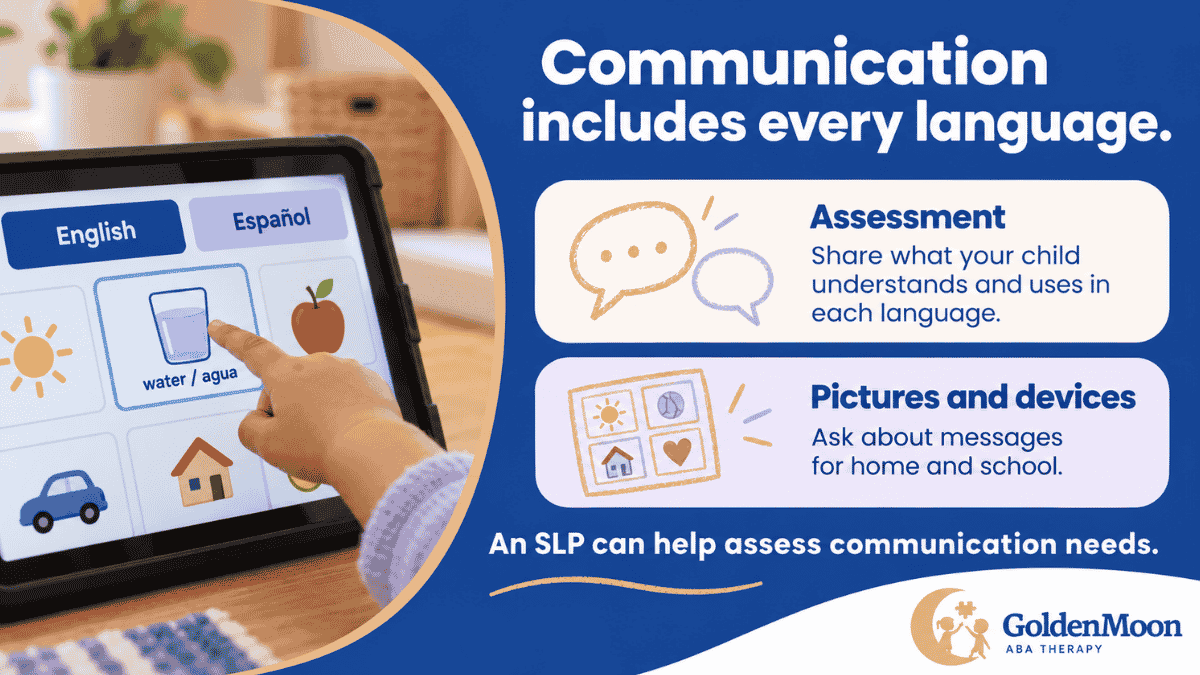
An assessment should consider the languages a child hears and uses. English skills alone may not show everything the child understands or can express. An SLP may gather information through caregiver interviews, observations, and activities across languages, with language assistance when needed.
ABA professionals and SLPs can contribute different skills to communication support. An ABA plan does not replace a speech-language assessment.
Pictures and Communication Devices
Some children use gestures, signs, picture boards, or devices that speak messages aloud. These methods are called augmentative and alternative communication (AAC).
Language needs also belong in AAC planning. A child may need English messages for school and Spanish messages for relatives. Some systems support multiple languages; an SLP can help assess the child’s needs and available options.
FAQs About ABA Therapy for Bilingual Children
Is it a problem if my child mixes Spanish and English?
Mixing words or grammar from different languages is an expected part of learning and using multiple languages. Language mixing alone does not establish a communication disorder. An SLP can assess broader concerns.
Does a bilingual child need more ABA therapy hours?
Bilingualism alone does not determine therapy hours. Recommendations should reflect the child’s assessed needs and treatment goals. A BCBA should explain the reasons for a proposed schedule.
Can an older sibling interpret therapy meetings?
A trained interpreter is the better option for clinical discussions. A sibling may miss treatment terms or feel uncomfortable translating sensitive information. Families can ask the provider how to arrange appropriate language assistance.
Discuss Your Family’s Language Needs With Our Team
Your child’s home language connects them with the people who care for them. Sharing how communication works in your household helps the care team understand which daily situations need attention.
At Golden Moon ABA, our home-based ABA and caregiver training support families across Maryland. During a free consultation, your family can share communication priorities, discuss your home language, and ask about support options for your household.