
Finding the right ABA provider for your child can feel like an overwhelming task — especially when you’re still processing a new diagnosis, navigating insurance, and trying to understand a field you’ve never encountered before. The stakes feel high because they are. The relationship between your child, your family, and your ABA provider will shape months or years of your lives.

The good news: once you know what to look for, the decision becomes much clearer. This guide walks Montgomery County families through the key questions to ask, the red flags to watch for, and the qualities that separate truly exceptional ABA providers from the rest. And if you’re already considering Golden Moon ABA, you’ll have the context to know exactly what to expect from us.
Start With Credentials — They’re Non-Negotiable
The most important thing to verify before anything else is whether the provider employs Board Certified Behavior Analysts (BCBAs) to oversee treatment. A BCBA is the licensed professional responsible for designing your child’s individualized therapy plan, conducting assessments, and adjusting the program based on data.
The Behavior Analyst Certification Board (BACB) maintains a public registry where you can verify any BCBA’s credentials. Legitimate providers will not hesitate when you ask about their clinical team’s certifications — in fact, they’ll be proud to share them.
Direct therapy sessions are typically delivered by Registered Behavior Technicians (RBTs), who work under BCBA supervision. Ask providers about their RBT-to-BCBA supervision ratio — the more frequently BCBAs observe and guide RBTs, the more consistent and high-quality your child’s sessions will be.
Questions to ask any provider:
- Is the treatment plan designed and overseen by a BCBA?
- How often will the BCBA observe my child’s sessions?
- How many clients does each BCBA supervise?
- Are your RBTs certified and trained in-house?
Look for Individualized, Not Cookie-Cutter, Treatment
ABA therapy is not one-size-fits-all. The National Institute of Child Health and Human Development emphasizes that effective autism treatment must be tailored to the specific needs, strengths, and goals of the individual child. A treatment plan built from a template — without a thorough initial assessment — is a warning sign.
A reputable ABA provider will begin with a comprehensive assessment before therapy starts. This evaluation identifies your child’s current skill levels, areas of need, and meaningful goals that reflect what matters most to your family. Goals like “will initiate a greeting with a peer” or “will complete a three-step morning routine independently” are specific and measurable. Vague goals are a sign that planning is not data-driven.
At Golden Moon ABA, every child begins with an individualized assessment. From there, our BCBAs collaborate with families to develop a treatment plan that reflects both clinical best practices and your family’s real-life priorities.
What Montgomery County Families Prioritize When Choosing an ABA Provider
Based on parent surveys and family feedback in the autism services community, here are the factors families report weighing most heavily when selecting a provider.
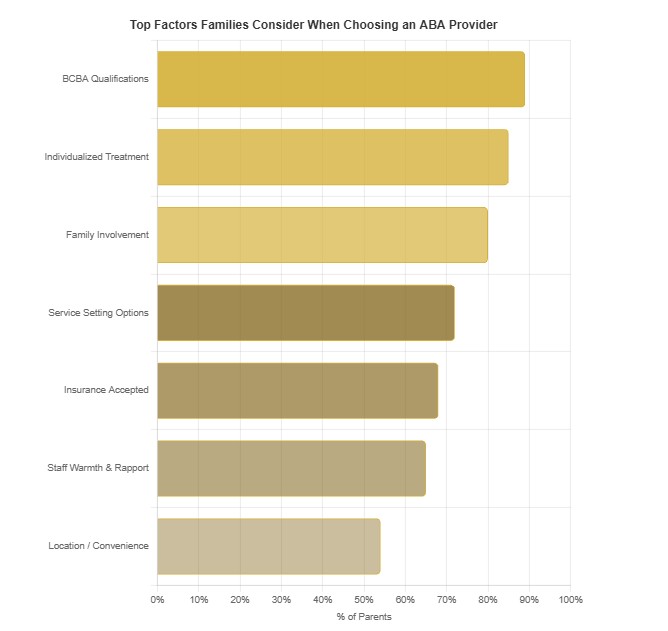
Illustrative data based on autism parent community surveys and published research on family decision-making.
Understand What 3 Service Settings Are Available
One of the most practical questions to ask is: where will therapy happen? Different settings serve different needs, and the best providers offer flexibility rather than forcing every child into the same model.
- Home-based ABA therapy is often the preferred starting point for younger children or those who are still getting comfortable with new adults. Therapy in a familiar environment reduces anxiety and creates natural learning opportunities in the spaces where the child actually lives.
- School-based ABA therapy is invaluable for children who need support generalizing skills into their academic setting. An RBT working alongside your child in the classroom can help with peer interactions, transitions, following instructions, and managing the demands of a school day.
- Telehealth ABA services have expanded dramatically in recent years and can be an excellent option for parent training, follow-up sessions, or families in areas of Montgomery County where in-person availability is limited.
Ask any provider you’re evaluating which settings they serve and whether they can adapt if your child’s needs change. Flexibility is a sign of a mature, family-centered operation.
Family Involvement Is Not Optional — It’s Essential
Exceptional ABA providers don’t treat parents as passive observers. Research from the autism research community — and decades of clinical experience — consistently shows that children make faster and more durable progress when parents understand and reinforce ABA strategies at home.
Look for providers who offer structured parent training as part of the program, not as an optional add-on. Parent training should teach you to recognize and reinforce the same behaviors your child’s RBT is working on — so that learning doesn’t stop when the session ends.
Red flags here include providers who are vague about what your child is working on, who don’t provide regular progress updates, or who seem reluctant to include you in goal-setting conversations. You should always know what your child’s current targets are and why they were chosen.
Watch for These 5 Green Flags
Beyond credentials and structure, there are softer but equally important signals that a provider is the real deal:
- They ask about your family’s priorities, not just your child’s deficits. Good ABA is strengths-based and family-centered.
- They explain everything clearly. BCBAs should be able to tell you why they’re using a specific technique, in plain language.
- Your child likes their therapist. Rapport matters enormously. A child who trusts and enjoys working with their RBT will make faster progress.
- They track and share data regularly. ABA is a data-driven discipline. You should see progress reports and have regular check-ins with your BCBA.
- They’re transparent about wait times and caseloads. Overstretched providers can’t give each child the attention they need.
Where Do Families in Montgomery County Prefer ABA Services to Be Delivered?
The breakdown below reflects reported setting preferences among families with children enrolled in ABA therapy in suburban Maryland.
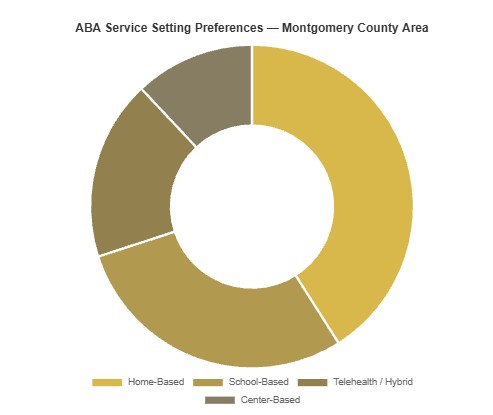
Illustrative data based on regional ABA program reports. Individual needs vary.
Ask About Maryland ABA Therapy Insurance and Wait Times Early
In Maryland, most major insurance plans are required to cover ABA therapy for children with an autism diagnosis. The Maryland Insurance Administration outlines the state’s autism insurance mandate, which applies to most employer-sponsored and individual plans.
When you contact a provider, ask upfront which insurance plans they accept and whether they handle insurance verification on your behalf. Many families are surprised by how much is covered — but only if the provider is properly credentialed with the right payers. At Golden Moon ABA, we work with families to navigate this process so it doesn’t become a barrier to getting started.
Also ask about current wait times. Quality ABA providers can sometimes have waitlists, and the earlier you reach out, the better position you’ll be in.
The Bottom Line in 2026: Trust Your Instincts, But Know What to Look For
Choosing an ABA provider is part research, part gut feeling. You want a team that’s clinically rigorous and genuinely warm — that sees your child as a whole person, not a set of behaviors to be managed.
Montgomery County families have options, and you deserve a provider that earns your trust every step of the way. If you’d like to learn more about how Golden Moon ABA approaches care, visit our services page or read more about our team’s approach on our ABA therapy overview page.
When you’re ready, schedule a free consultation with our team. We’ll answer every question you have — and we’ll help you figure out if we’re the right fit. No pressure, no jargon, just a real conversation about your child.