
Watching your child grow up is filled with magical milestones – their first laugh, their unique little personality forming, and the way they curiously explore the world. But sometimes, as a parent or caregiver, you might feel a quiet sense of worry if they seem to be interacting, talking, or playing differently than other kids their age. If you are noticing persistent challenges with communication, intense emotional meltdowns, or highly rigid habits, you might have heard professionals mention Applied Behavior Analysis (ABA) therapy.
6 Signs That Your Child Will Benefit from ABA Therapy:
Here are six common signs that your child might benefit from the structured, compassionate support of ABA therapy.
1. Significant Speech and Social Communication Delays
Communication forms the bedrock of our relationships, but for many neurodivergent children, expressing simple wants and needs can feel incredibly frustrating. You might notice that your child is entirely nonverbal, has experienced a sudden loss of words they once used regularly, or frequently engages in echolalia—the automatic repetition of phrases made by another person without immediate communicative intent.
The Centers for Disease Control and Prevention (CDC) highlights that tracking these developmental milestones is a vital way for families to identify early warning signs and connect with early intervention services. When a child struggles to vocalize, ask for help, or read nonverbal cues like facial expressions, ABA therapy steps in by breaking down language acquisition into small, digestible steps, replacing frustration with functional speech or alternative communication methods.
2. Difficulty Forming Friendships and Navigating Shared Play
Does your child consistently prefer to play entirely alone, treating peers more like objects in space rather than playmates? Building friendships requires a complex web of social skills, including turn-taking, sharing, and understanding perspectives. If your child struggles to engage in reciprocal social interaction or avoids maintaining eye contact, they can find traditional classroom or playground environments highly isolating.
As noted by the experts at the University of Alabama Autism Clinic, a primary goal of structured behavioral support is to safely increase helpful social interactions and self-regulation. ABA specialists explicitly teach these nuanced social codes through structured play dates and modeling, ensuring your child learns the foundational skills to joyfully play alongside or with their peers.
3. Intense Distress Over Minor Routine Changes or Transitions
Flexibility can be incredibly challenging for children who rely heavily on absolute predictability to feel safe. If your child requires a highly specific sequence for daily tasks—like taking an identical driving route to school or lining up toys in an exact configuration—minor changes can spark severe emotional distress.
Moving from one activity to another (such as turning off the television to eat dinner) might regularly lead to prolonged crying or rigidity. Clinical researchers at Florida Tech have shown how early intervention using ABA techniques can help minimize this intense transition anxiety. By slowly introducing structured tools like visual schedules, proactive transition notices, and consistent positive reinforcement at home, a behavioral therapist helps your child build authentic cognitive flexibility and adapt to life’s inevitable surprises.
4. Frequent Maladaptive Behaviors like Aggression or Self-Injury
When a child feels utterly overwhelmed and lacks the communication tools to express their internal state, they may turn to intense physical actions. This can look like frequent, explosive tantrums, throwing objects, bolting from safe areas (elopement), or biting and hitting others. Even more concerning are self-injurious behaviors, such as head-banging or scratching themselves.
ABA therapy looks at these behaviors through a scientific lens to figure out their functional cause. Every behavior serves a distinct function—typically escape, attention-seeking, tangible access, or internal sensory stimulation—as outlined by UMass Global. Rather than simply punishing the action, an ABA therapist determines exactly what the child is trying to achieve and explicitly teaches a safe, appropriate alternative skill to meet that need.
5. Challenges with Fundamental Daily Living and Adaptive Skills
Sometimes the signs aren’t just about communication or behavior; they can manifest in everyday life skills that other children pick up implicitly. If your child struggles significantly with toilet training, resists eating foods outside of an extremely narrow texture profile, or has major difficulties with personal hygiene routines like brushing teeth and getting dressed, it can create immense stress for the entire household.
The Indiana University HANDS in Autism Center underscores that data-driven, individualized practices are crucial for helping individuals master these practical adaptive behaviors. ABA breaks down complex multi-step processes into sequential chains, rewarding your child for mastering each individual piece until they achieve true, proud independence.
6. Repetitive Physical Movements or Extreme Sensory Needs
Does your child spend long periods hand-flapping, body-rocking, spinning in circles, or intently studying the moving parts of objects, like the wheels on a toy car? These actions, often called “stimming,” are a child’s way of regulating their sensory system.
While stimming itself isn’t inherently harmful, it can become a barrier to learning if it consumes most of their day or prevents them from focusing on their environment. Similarly, a child may show severe hyper-sensitivity or hypo-sensitivity to sights, sounds, or textures. ABA therapy helps design balanced environments that satisfy these intense sensory needs in healthy, structured ways, ensuring your child can find comfort without missing out on learning opportunities.
Empowering Families Through Collaboration
It is important to remember that modern ABA therapy is not a one-size-fits-all, rigid program. It is a highly collaborative framework where Board Certified Behavior Analysts (BCBAs) work closely with families to establish goals that directly improve the quality of life for the child.
Therapy plans are tailored to fit your home dynamic, ensuring that techniques used during sessions can be naturally mirrored by parents and teachers. This consistency creates a supportive environment where your child can practice new skills safely across different settings.
The Data Behind Early, Comprehensive ABA: What the Progress Looks Like
When families look into developmental options, they naturally want to know: Does it actually make a measurable difference compared to no treatment? The data strongly favors early intervention. Clinical research studying Early Intensive Behavioral Intervention (EIBI)—which typically involves 20 to 40 hours a week of structured ABA therapy initiated around age two or three—shows clear divergence between children who receive it and those who do not.
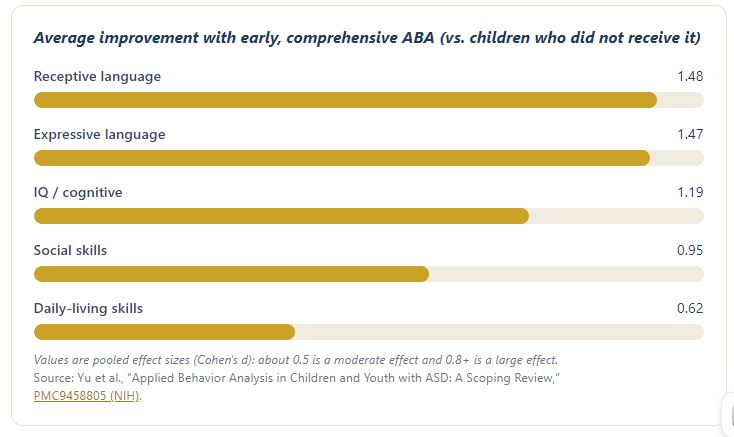
On average, children who undergo early, comprehensive ABA therapy achieve an average IQ increase of 9 to 15 points compared to peers who receive standard community care or no intensive therapy. Furthermore, long-term tracking shows substantial improvements in adaptive behavior scales. While children without intensive support often struggle to keep pace with social, communication, and daily living skills as they grow, children enrolled in early ABA see average baseline improvements of over 12 points in these metrics within their first year. By leveraging a young child’s natural neuroplasticity, intensive ABA can translate to significantly higher rates of successful integration into regular education classrooms later on.
Understanding the Numbers: How Often Autism Is Identified in the U.S.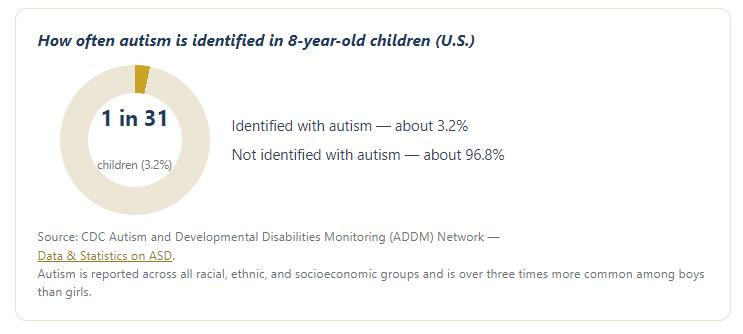
If you feel overwhelmed navigating a potential diagnosis, it helps to understand that your experience is shared by millions of families across the country. Identification rates have shifted dramatically over the past two decades due to vastly improved pediatric screening tools, wider medical awareness, and a concerted effort to reach historically underserved communities.
According to the latest surveillance network report released by the CDC, an estimated 1 in 31 children (approximately 3.2%) aged eight in the United States are identified with Autism Spectrum Disorder (ASD). To put that into perspective, the rate stood at roughly 1 in 150 in the early 2000s. This steady upward trajectory doesn’t necessarily indicate a rise in the occurrence of autism itself, but rather that clinicians, parents, and schools are significantly better at recognizing the subtle presentation of symptoms early in life. The data also reveals that autism is identified roughly 3.4 times more frequently in boys (about 1 in 20) than in girls (about 1 in 70), driving ongoing efforts to close the diagnostic gap for girls who often learn to mask their difficulties.
Taking the Next Steps for ABA Therapy
Recognizing these signs in your child is the first step toward getting them the tailored, compassionate support they deserve. If any of these points feel all too familiar, it is highly recommended to speak openly with your child’s pediatrician to schedule a formal developmental screening. Remember, seeking out behavioral support isn’t about altering who your child is—it is about providing them with a customized toolkit to help them communicate clearly, thrive socially, and confidently navigate the world on their own terms.