

TL;DR
- An IEP is a legal document written by a school team; ABA therapy is a clinical service delivered by a behavior analyst and technicians. They are separate systems that can share the same goals.
- ABA supports IEP goals most directly in communication, behavior regulation, work completion, social skills, and daily living skills.
- Data is the bridge. A behavior analyst who shares clean progress data gives the IEP team evidence for what is working across settings.
- In Maryland, families may also encounter the Autism Waiver, which is administered through the state education agency and connects to the IEP process.
Two school systems for one child
Families often arrive at their first IEP meeting expecting the school to simply continue what the home ABA team is doing. It rarely works that way, and understanding why saves a great deal of frustration.
An individualized education program is created under federal special education law, which entitles eligible children to a free appropriate public education and requires the school team to write measurable annual goals tied to educational need. ABA therapy, by contrast, is a medical service authorized by insurance, delivered on a treatment plan written by a board certified behavior analyst. Different funding, different documentation, different legal footing.
What the two share is the child, the data, and often the exact skill in question. A goal like asking for a break instead of leaving the room matters in a third grade classroom and at the kitchen table. When both teams work on it with compatible strategies, progress accelerates. When they use contradictory approaches, the child gets whiplash.
Where ABA and IEP goals overlap most
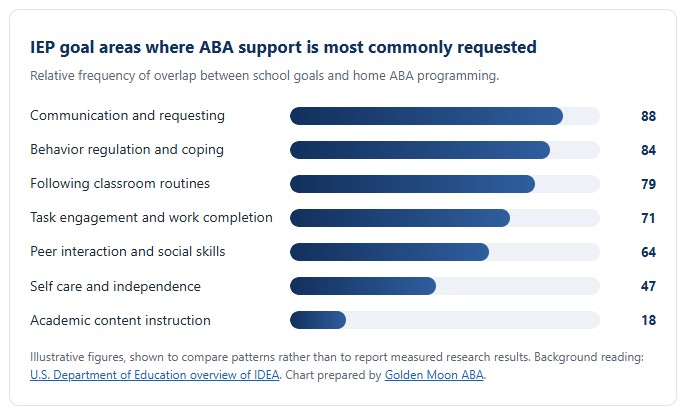
Not every IEP goal has an obvious behavioral counterpart. Reading fluency and math computation belong to instruction. But a large share of what holds a child back in school is behavioral in nature, and that is where ABA has the most to contribute.
 Source
The pattern is worth noticing before your next meeting. If your child’s IEP is heavy on academic goals and light on the communication and regulation goals that actually determine whether the academics land, that imbalance is something you can raise.
Data is the bridge between clinic and classroom
The most useful thing an ABA team brings to an IEP meeting is not an opinion. It is measurement. Behavior analysts collect frequency, duration, and independence data on every target, which means they can say that prompted requesting fell from nine prompts per hour to two over eleven weeks. School teams work with the same logic, since IDEA requires progress to be reported against measurable goals.
Practical steps help. Ask your analyst for a one page summary before the meeting, written in plain language, listing current goals, baseline, and current level. Ask the school for their data collection method on each goal. Where the two overlap, propose that both teams record the same behavior the same way for a term.
Teacher preparation resources on writing high quality IEPs emphasize the same principle: present levels need to serve as a real baseline, and goals need a monitoring method a busy person can actually use. Coming to the table with clean numbers makes you a partner rather than a petitioner.
Strategies that travel between home and school
Behavioral practice has a well documented core: reinforcement, prompting and prompt fading, visual supports, task analysis, and structured teaching. Public school teams already use these. Free training libraries of evidence based practices were built specifically so teachers, paraeducators, and families could use consistent methods with the same learner.
That shared vocabulary is your leverage. Rather than asking a school to adopt your home program, ask whether a specific strategy that works at home can be mirrored in the classroom: the same visual schedule format, the same break request card, the same wording for a two step direction. Small alignments carry further than sweeping requests.
Where a school team is open to it, a behavior analyst can observe in the classroom and consult with staff. Our school based ABA services are built around that collaboration, with the school retaining authority over the IEP and the clinical team supporting implementation.
Maryland specifics worth knowing
Maryland families should know about the Medicaid Autism Waiver, a home and community based services waiver operated by the state education department for Medicaid. It provides services and supports in the home and community, and your local school system arranges the service coordination. Eligibility rules are specific and waiting lists exist, so ask early rather than at the point of crisis.
Each county also runs its own special education office, and Montgomery County Public Schools has its own timelines, forms, and staffing patterns. Ask your case manager who attends meetings and how progress reports are sent home. Parents in Silver Spring and Bethesda often find that a short email two weeks before a meeting shapes the agenda more than anything said in the room.
Preparing for the meeting itself
Write down three priorities before you go. Bring the one page data summary. Ask for draft goals in writing beforehand and read them for measurability: a goal you cannot picture someone counting will not be tracked. If you disagree, ask for that to be noted, then request the data that would settle it.
Parent training pays off here too, because the vocabulary becomes familiar and the meeting stops feeling like a foreign language. Families working with Golden Moon ABA often use a session before an IEP meeting to rehearse questions and organize documents. You can also schedule a consultation if you want a behavior analyst’s read on draft goals before you sign anything.
Commonly asked questions about IEP and ABA in 2026:
Can my ABA provider attend the IEP meeting?
Yes, if you invite them. Parents may bring people with knowledge or special expertise about the child. Tell the school in advance so the meeting is scheduled with enough time, and confirm that your provider has whatever release is needed to share clinical information.
Does the school have to provide ABA if my child has autism?
Schools are required to provide the special education and related services a child needs to make appropriate progress, but they are not required to deliver a specific commercial methodology by name. Many Maryland schools use behavioral strategies within their programs without labeling the service as ABA.
Can ABA sessions happen during the school day?
Sometimes, though it depends on the district, the school, and the reason. Some families arrange clinic sessions before or after school precisely to avoid instructional time. Others negotiate limited push in support. Start the conversation with the case manager rather than assuming either answer.
What if home data and school data disagree?
Disagreement is usually information rather than conflict. A skill that appears at home but not at school often signals a generalization gap, a different set of demands, or different reinforcement. The productive next step is a shared measurement plan, not a debate about who is right.
How often should IEP goals be reviewed?
The IEP team must review the IEP at least annually, and a parent may request a meeting sooner if progress stalls or circumstances change. Clinical treatment plans typically get revised more often, every six months in many cases, which is one reason the two documents drift apart without deliberate coordination.