
TL;DR
- Home based ABA teaches skills where your child already lives, which makes routines, family interaction, and generalization easier.
- Clinic based ABA offers a controlled setting, easy access to peers, and a team of clinicians in one building, which helps with focus and with complex behavior.
- The better question is usually not which setting is superior, but which setting matches your child’s current goals, your family’s schedule, and your child’s tolerance for transitions.
- Many families change settings over time or use both, and a good provider will revisit the decision as goals shift.
What each setting actually looks like
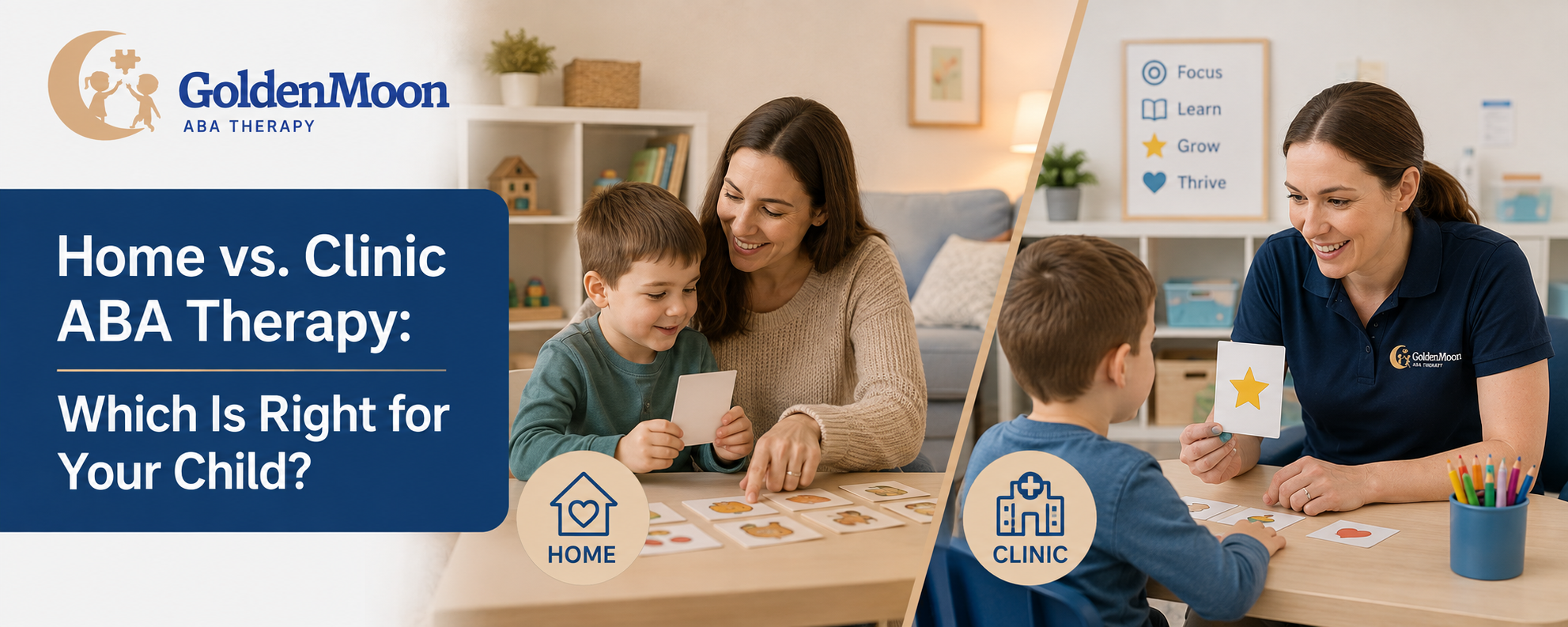
In home based ABA, a technician arrives at your house and works with your child in the kitchen, the play area, the bathroom, sometimes the front yard. Sessions use your materials and your routines. A behavior analyst supervises regularly, adjusts the plan, and trains caregivers. Siblings and pets are part of the environment rather than a distraction to be removed.
In clinic based ABA, your child comes to a center built for therapy: dedicated rooms, prepared materials, other children nearby, and several clinicians on site. Sessions often run longer blocks, and a child may work with more than one technician in a day. Academic medical centers describe their clinic based programs as team environments where a child’s strengths and needs are addressed by several disciplines under one roof.
Both settings apply the same science. Federal health agencies note that behavioral approaches have the strongest evidence for treating symptoms of autism and are widely used in both schools and treatment clinics. The setting changes the texture of the work, not the principles behind it.
The case for home based therapy
The strongest argument for home based ABA therapy is generalization. A child who learns to request a snack in a therapy room still has to do it in a kitchen, with a parent, at five o’clock, while a sibling is shouting. Teaching in the kitchen removes that transfer step entirely.
Home also reaches the goals that only exist at home. Bedtime, getting dressed, tolerating the bath, sitting for a family meal, playing near a sibling without conflict: these are the things parents describe as the hardest part of the week, and they cannot be recreated convincingly in a clinic room.
Caregiver involvement is easier too. When the analyst is in your house, coaching happens naturally, and the strategies you learn get practiced immediately. Descriptions of behavioral management therapy from federal child health researchers emphasize approaches like pivotal response training that take place in a child’s everyday environment for exactly this reason.
Finally, there is the practical matter of time. No commute, no waiting room, no packing a bag. For families in Silver Spring and Rockville juggling work and other children, that can be the difference between a sustainable schedule and one that collapses in a month.
The case for clinic based therapy
Clinics have advantages that a living room cannot match. Distractions are controlled. Materials are prepared and varied. If a child is working on tolerating an unfamiliar setting, the clinic itself is the teaching tool.
Peers matter as well. Group work, parallel play, turn taking, waiting in a line: these targets need other children, and a clinic supplies them naturally. Multiple clinicians on site also keep skills from becoming locked to one familiar adult.
For complex or intensive cases, the concentration of expertise is significant. Specialty autism centers staff behavior analysts, psychologists, speech and occupational therapists, and physicians in one place, which makes coordination faster when a child’s needs cross disciplines.
Comparing the two on what parents actually ask about
The chart below compares typical strengths of each setting across the factors families raise most often. No setting wins on everything, which is the point.
Home based and clinic based ABA compared on common parent priorities
Higher bars indicate the setting that typically handles that factor more easily. Home based shown first, clinic based second, for each factor.
Illustrative figures, shown to compare patterns rather than to report measured research results. Background reading: CDC overview of treatment and intervention for autism spectrum disorder. Chart prepared by Golden Moon ABA.
Read it as a set of trade offs rather than a verdict. A child who needs peers and structure may thrive in a clinic even though the commute is painful. A child who falls apart during transitions may make faster progress at home even though the living room is noisy.
Questions that usually settle the decision
Five questions tend to clarify things quickly. What are the top three goals right now, and where do those behaviors happen? How does your child handle new places and new people? Can your family sustain the travel involved? Is there an adult available at home during session hours? And is your child’s behavior safe enough for a technician to manage in a home without backup nearby?
That last question is not about blame. Some behavior needs more than one trained adult in the room, and a clinic can supply that safely. Being honest about it early prevents a series of canceled sessions and a discouraged family.
It is also worth asking about hours. Intensive early programs of 20 or more hours a week are harder to sustain at home for some families and easier for others. There is no universal answer, only your answer.
Choosing, and changing your mind later
Settings are not permanent. Plenty of children start in a clinic to build attending and instruction following, then move home to work on routines and family life. Others start at home while very young and add clinic or group time as they approach school age.
Hybrid arrangements are common and often the most practical: home sessions during the week, a clinic or community outing session for peer skills, and virtual parent training to keep caregivers current. Learn more about our home based ABA program, or read about the team behind it on our about page. The clinicians at Golden Moon ABA can walk through your child’s goals and tell you honestly which setting fits them today.
Frequently asked questions
Is home based ABA less effective than clinic based ABA?
No. The evidence supports behavioral intervention broadly rather than one setting over another. Effectiveness depends more on hours, plan quality, supervision, and caregiver involvement than on the room the work happens in.
Does my house need to be tidy or specially set up?
It needs to be safe and workable, not staged. Teams work in ordinary homes every day. A consistent space with a table or floor area, minimal screen access during the session, and materials within reach is enough.
Can we do both home and clinic?
Often yes, though insurance authorization and staffing determine what is practical. Ask your provider whether they offer both and how supervision hours would be divided.
Which setting is better for a newly diagnosed toddler?
Many young children start at home, where a familiar adult and familiar environment reduce the stress of beginning services. Some families choose a clinic for the structure and the team on site. Either can be right, and the decision should be revisited after a few months.
How many hours per week does my child need?
It depends on age, goals, and assessment results rather than on setting. A behavior analyst recommends a range after an assessment, and the insurance plan authorizes hours based on that recommendation.