
What Is Virtual ABA Therapy?
Virtual ABA therapy (also called telehealth ABA or online ABA) delivers applied behavior analysis services through secure video conferencing instead of, or alongside, in-person sessions. A Board Certified Behavior Analyst (BCBA) connects with your child and family from a distance, guiding skill-building activities, observing behaviors in real time, and coaching parents on evidence-based strategies.
The approach has grown rapidly since 2020, but its foundations are well established. The National Institute of Child Health and Human Development (NICHD) recognizes ABA as a widely accepted method for supporting children with autism spectrum disorder (ASD). And the CDC’s treatment and intervention page for ASD notes that behavioral approaches, including ABA, can be delivered across settings: in homes, schools, clinics, and now through telehealth. For Maryland families seeking flexible scheduling and reduced travel time, Golden Moon ABA’s telehealth services provide a convenient option that keeps therapy consistent and accessible.
Why Families Are Choosing Virtual ABA
There are several practical reasons families across Montgomery County and beyond are turning to virtual sessions as part of their child’s treatment plan.
Reduced Travel and Scheduling Flexibility
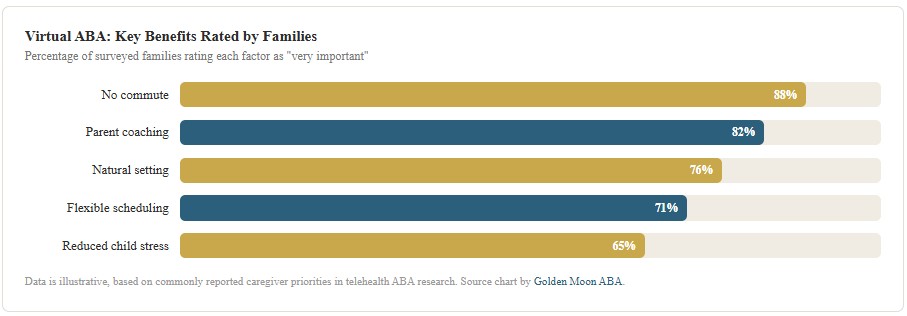
Getting to and from appointments takes time, and for families juggling multiple children, school schedules, or work obligations, that time adds up quickly. Virtual sessions eliminate the commute and allow therapy to happen where your child is most comfortable: at home. Many families find that sessions fit more easily into the day when travel is removed from the equation.
Therapy in the Child’s Natural Environment
One overlooked advantage is that a BCBA can observe your child in the environment where behaviors actually occur. Mealtimes, transitions between activities, sibling interactions: these real-life moments are difficult to replicate in a clinical setting. When the therapist can see these situations firsthand through video, the treatment plan can be more targeted and relevant to daily life.
Stronger Parent Involvement
Virtual ABA sessions often position parents as active participants rather than passive observers. According to a peer-reviewed study published by the National Institutes of Health (NIH), training parents to implement ABA procedures via telehealth resulted in a greater than 90% reduction in problem behavior across all service delivery models studied, and parent satisfaction ratings were consistently high. This kind of parent-mediated therapy can extend the benefits of ABA far beyond the scheduled session time.
What Does a Virtual ABA Session Look Like?
If you have never participated in a virtual therapy session, it is natural to wonder what the experience involves. Here is a typical structure:
The session begins with a brief check-in. Your BCBA reviews any updates since the last session, discusses how specific strategies have been working at home, and identifies the focus areas for the day. From there, the therapist guides your child through structured activities while coaching you in real time. For younger children, this often means the BCBA directs a parent to present tasks, model responses, and deliver reinforcement based on the child’s behavior. For older or more independent children, the BCBA may work directly with the child via video on social skills, self-management, or academic readiness tasks.
Sessions typically last between 30 and 60 minutes, depending on your child’s age, attention span, and treatment goals. The BCBA takes data throughout and uses those records to adjust the treatment plan over time.
Is Virtual ABA as Effective as In-Person Therapy?
This is probably the most common question families ask, and the evidence is encouraging. Research published through the NIH’s PubMed Central found that providers across multiple ABA disciplines reported positive outcomes from telehealth services for children with ASD. The study, which included providers from 17 institutions across the United States and Canada, highlighted that telehealth was particularly effective for parent training, behavior management, and treatment planning.
That said, virtual ABA is not always a complete replacement for in-person services. Children who need intensive hands-on prompting, those working on certain motor skills, or those with limited attention for screen-based interaction may benefit from a hybrid model that combines virtual and in-person sessions. A qualified BCBA will assess your child’s unique needs and recommend the right balance.
What You Need to Get Started
Setting up for virtual ABA is simpler than most families expect. The U.S. Department of Health and Human Services telehealth guide for patients recommends that families have a reliable internet connection, a device with a camera and microphone (a laptop, tablet, or smartphone), and a quiet space where the session can take place without too many distractions.
Beyond the technology, preparation also involves having a few preferred items or reinforcers nearby. Your BCBA will let you know which materials to have on hand before each session. Many families set up a small, consistent workspace: a table, a chair, and a bin of therapy materials. Consistency in the physical setup helps children transition into “therapy mode” more smoothly.
Insurance Coverage and Accessibility
Most major insurance plans in Maryland now cover telehealth ABA services, including Medicaid. Coverage expanded significantly during the pandemic, and many of those policy changes have been made permanent or extended. It is always a good idea to verify your specific plan’s telehealth benefits before starting services.
At Golden Moon ABA, the intake team helps families navigate insurance verification and authorization for virtual sessions. You can reach the team through the contact page or schedule an appointment directly.
Tips for a Successful Virtual ABA Experience
Making virtual therapy work well involves a few small adjustments that can make a big difference over time.
First, choose a consistent location in your home and minimize background noise and visual distractions during sessions. Turn off televisions, put phones on silent, and close doors when possible. Second, keep therapy materials organized and accessible so you do not lose session time searching for items. Third, communicate openly with your BCBA between sessions. If a strategy is not working at home, or if your child’s routine has changed, sharing that information helps the therapist adjust the plan quickly.
Finally, be patient with the process. It is common for children to need a few sessions to adjust to the video format. Some children take to it immediately; others need a gradual introduction. Your BCBA can help with strategies to build your child’s comfort with the screen over time.
When to Consider a Hybrid Approach
Virtual ABA works well for many families, but some children benefit from a combination of virtual and in-person services. A hybrid model might be right for your family if your child needs physical prompting for certain skills, if you are working on community-based goals like grocery store behavior, or if your child’s attention span for screen-based activities is still developing.
Golden Moon ABA offers both home-based ABA and telehealth services, and the clinical team works with each family to determine the right mix. Many families start with one model and adjust as their child grows and their goals evolve.
Frequently Asked Questions
Is virtual ABA therapy covered by insurance in Maryland?
Yes, most major insurance plans in Maryland cover telehealth ABA services. Medicaid plans have included telehealth ABA coverage since the pandemic-era expansions, and many commercial insurers have followed suit. Always confirm your specific plan’s benefits with your provider before beginning services.
What ages are appropriate for virtual ABA?
Virtual ABA can be effective for children as young as 2 or 3 when sessions focus heavily on parent coaching. For older children and teens, sessions can be more direct and independent. Your BCBA will assess your child’s readiness and recommend the best format based on developmental level and goals.
How long are virtual ABA sessions?
Sessions typically range from 30 to 60 minutes. The length depends on your child’s treatment plan, age, attention capacity, and the specific goals being addressed. Some children receive multiple shorter sessions per week; others have fewer, longer sessions.
Can virtual ABA replace in-person therapy entirely?
For some families, yes. For others, a hybrid model works best. Children who need hands-on prompting, intensive motor skill work, or community-based practice may benefit from some in-person sessions alongside virtual ones. Your treatment team will help you find the right balance.
What happens if my child will not sit still for a video session?
This is a common concern, and it is completely normal. BCBAs are trained to work with children who move around, lose focus, or resist the screen. Sessions can include movement breaks, preferred activities, and gradual exposure to the video format. Many children who struggle initially become comfortable within just a few sessions.
Do I need special equipment?
No special equipment is required. A laptop, tablet, or smartphone with a camera and stable internet connection is sufficient. The CDC’s autism data and statistics page highlights growing accessibility of services for ASD families, and telehealth is a key part of that trend. Your therapy provider will walk you through any platform-specific setup before your first session.
Taking the Next Step
Virtual ABA therapy has made quality behavioral support more accessible than ever for Maryland families. You can also read more about the full range of services, including parent training and school-based ABA on our site.
Whether you are just beginning to consider ABA services or looking to add telehealth to an existing treatment plan, the most important step is connecting with a qualified provider who can assess your child’s needs and build a plan that fits your family’s life.